History of Indian Stock Exchanges: From BSE to NSE and Modern Trading
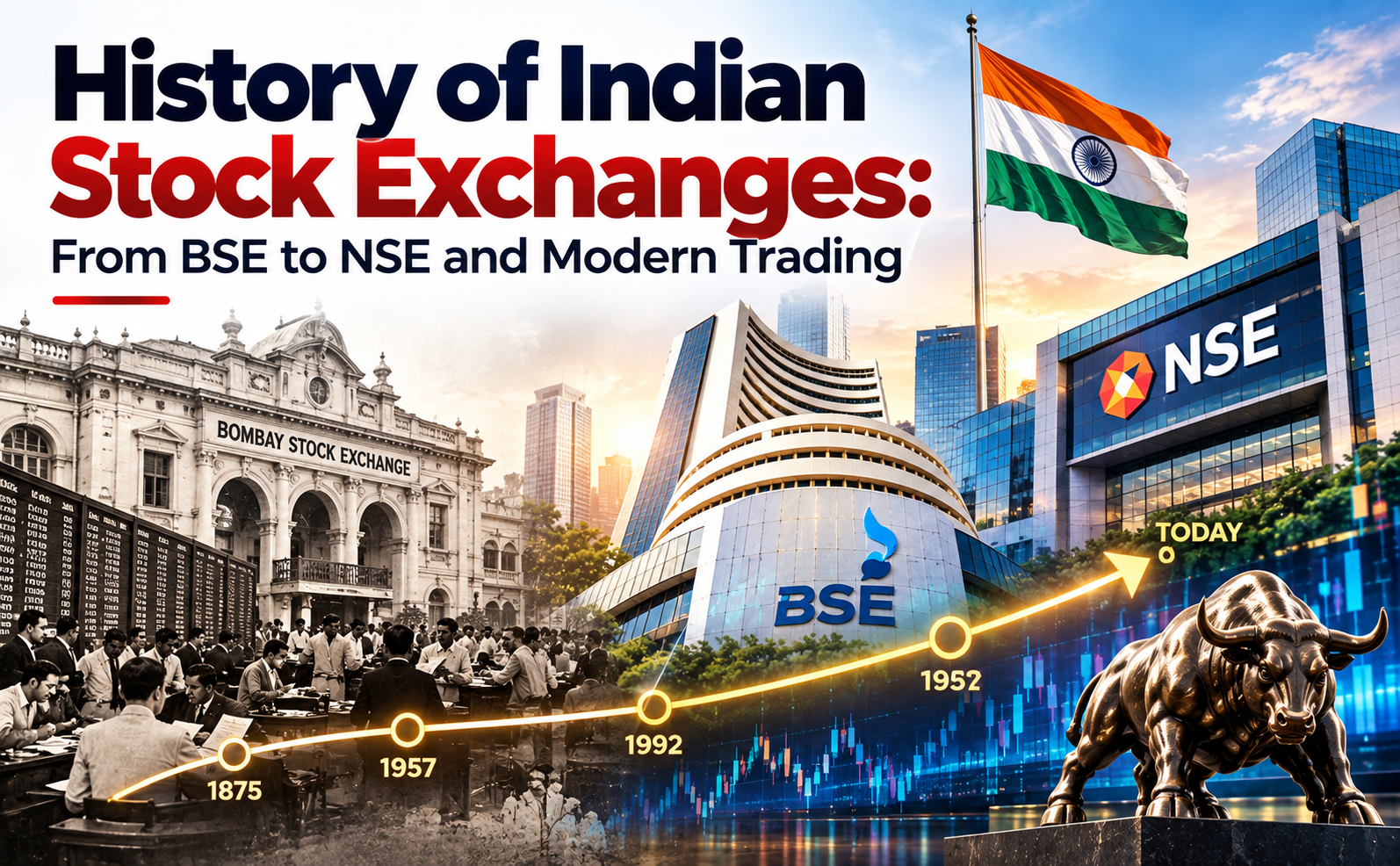
The history of Indian stock exchanges goes back over 100 years, starting with the opening of the Bombay Stock Exchange in 1875 and continuing with the growth of electronic trading through the NSE. Discover important events, SEBI reforms, demat accounts, benchmark indices, and how India's stock market has developed.
Introduction to the History of Indian Stock Exchanges
The history of Indian stock exchanges shows how the country's financial system changed from informal trading to a modern, technology-based marketplace. Over the years, stock exchanges have helped businesses raise funds, allowed investors to trade stocks, and supported the growth of India's capital markets.
The Bombay Stock Exchange (BSE), founded in 1875, is a key milestone in this history. The National Stock Exchange (NSE), which was established in 1992 and started trading in 1994, introduced electronic trading across the country, greatly changing how securities are bought and sold in India.
Reforms in regulations, electronic trading, dematerialization of securities, and improved market infrastructure have made the Indian stock market more accessible and transparent. Understanding this development is crucial for learning about initial public offerings (IPOs), listed companies, market indices, and stock market operations.
Early Beginnings of the Indian Stock Market
The roots of organized securities trading in India can be traced back to Bombay, now Mumbai, in the 19th century. During this time, economic activity and commercial growth increased interest in trading shares and other financial instruments.
Before formal exchanges were established, brokers carried out transactions in informal groups. As trading grew, the need for a structured marketplace with established rules became necessary.
In 1875, a group of brokers formally created the Native Share and Stock Brokers' Association in Bombay. This organization became the foundation of what is now known as the Bombay Stock Exchange, marking a significant step forward for organized securities trading in India.
Bombay Stock Exchange (BSE): The Start of Organized Trading
The Bombay Stock Exchange (BSE) was established in 1875 and is recognized as Asia's oldest stock exchange. Its development went hand in hand with the growth of India's commercial and industrial economy.
Over time, the exchange created a more organized environment for trading shares and securities. It became an essential platform for companies seeking investors and for market participants wanting to trade listed securities.
Key Developments in BSE History
- 1875: The Native Share and Stock Brokers' Association was officially established in Bombay.
- Late 19th century: Organized trading activity grew alongside the expansion of businesses.
- 20th century: BSE improved its trading infrastructure and became a central part of India’s securities market.
- Modern era: Electronic systems transformed trading, moving from traditional floor trading to quicker computer-based transactions.
BSE has been crucial in the growth of India's capital market by providing a platform for listed companies and investors. It also operates main indices that help market participants track the movements of selected stocks.
National Stock Exchange (NSE): A New Era of Electronic Trading
The National Stock Exchange (NSE) was incorporated in 1992, recognized by the Securities and Exchange Board of India (SEBI) in 1993, and began operations in 1994.
NSE introduced fully automated, screen-based trading in India. Rather than relying mainly on physical trading floors and in-person interaction between brokers, investors and trading members could place orders electronically.
This technology-driven approach increased access to stock market trading across the country, improved the process of matching buy and sell orders, and enhanced price transparency.
Important NSE Milestones
- 1992: NSE was incorporated.
- 1993: NSE received recognition as a stock exchange from SEBI.
- 1994: NSE launched its equity trading segment using electronic systems after starting in the wholesale debt market.
- 1996: The Nifty 50 index was introduced, providing a benchmark for tracking large, listed companies on NSE.
- 2000: NSE launched index options based on the Nifty index and expanded its derivatives offerings.
- Later years: Online trading, mobile access, and new financial products continued to enhance the exchange's services.
The development of NSE greatly influenced how Indian securities are traded. Its electronic trading model helped create a more accessible and technology-focused market structure.
The Establishment and Role of SEBI
The Securities and Exchange Board of India (SEBI) is the main regulator of India’s securities market. It was first formed in 1988 and became a statutory body under the SEBI Act in 1992.
As India's capital markets expanded, regulation became vital for protecting investors, ensuring orderly trading, and promoting transparency. SEBI's duties include regulating market participants and exchanges, overseeing compliance with rules, and safeguarding investors' interests.
Regulatory developments have established a framework for public offerings, disclosure requirements, market behavior, and the operations of intermediaries. These measures are particularly important for investors involved in IPOs and trading listed securities.
For official information about SEBI and its responsibilities, visit the SEBI website.
Transition from Physical Trading to Electronic Markets
A major change in the history of Indian stock exchanges was moving from traditional floor trading to electronic trading.
In earlier systems, brokers communicated on trading floors to negotiate and carry out transactions. While this method supported organized trading, it had limitations regarding geographic reach, speed, and market information access.
Electronic trading enabled computer-based order placement and matching, allowing investors to access the market through registered trading members without being physically present at an exchange.
Key changes in electronic trading included:
- Faster order execution: Automated systems improved the speed of matching orders.
- Broader market access: Trading was made available to participants in different locations.
- Improved price visibility: Electronic systems provided easier access to market prices and order information.
- Better monitoring: Computerized records and surveillance helped oversee trading activities.
- Growth of online investing: Internet platforms and mobile applications enabled easier access to market services.
This shift laid the groundwork for the technology-driven stock market that investors use today.
Dematerialization: Moving to Electronic Securities
Dematerialization, or the shift to electronic securities, was another significant development. Before this, investors typically held shares as physical certificates, which could involve paperwork, transfer delays, and risks of loss or forgery.
Dematerialization allowed securities to be held electronically in depositories. The creation of the National Securities Depository Limited (NSDL) in 1996 marked a key step in this change.
Holding securities electronically simplified transfers and supported efficient settlement processes. Today, investors typically use demat accounts to hold eligible securities electronically, while trading accounts are used to place orders through registered brokers.
Development of Major Indian Stock Market Indices
Stock market indices help investors track the performance of a specific group of securities. They serve as benchmarks for analyzing market changes and comparing investment results.
BSE Sensex
The BSE Sensex is a key index associated with BSE, tracking major companies listed on the exchange and widely regarded as a measure of movements in India's equity market.
Nifty 50
The Nifty 50 is a flagship index linked to NSE. Launched in 1996, it follows a selection of large, actively traded companies from various sectors of the Indian economy.
Both indices are frequently referenced by investors, analysts, and financial media to discuss market trends. However, the performance of an index does not always reflect the returns of every listed stock or each investor's portfolio.
Growth of IPOs and the Indian Primary Market
As stock exchanges and market systems improved, the Indian primary market became a crucial way for companies to raise funds from public investors.
An Initial Public Offering (IPO) allows a company to sell shares to the public and seek listing on a stock exchange. IPOs help companies raise money for growth, repay debt, support business plans, or provide exit opportunities for current shareholders.
Modern IPO processes involve electronic applications, disclosures, subscription reporting, allotment procedures, and listing on exchanges. Investors can review various information before deciding whether to participate in an IPO.
- IPO subscription data allows investors to see demand across different investor groups.
- IPO allotment status enables applicants to check their results after the allotment process.
- IPO market analytics helps analyze IPO activities and market trends.
- IPO listing performance lets users review historical listing outcomes.
These resources serve different purposes and should be considered alongside the company's offer documents, financial health, valuation, and associated risks. Past performance of listings does not guarantee future IPO outcomes.
How Indian Stock Exchanges Operate Today
India's stock market operates through a network of exchanges, brokers, clearing corporations, depositories, and other regulated participants. BSE and NSE are the two main equity exchanges in the country, each providing trading opportunities for eligible securities under the relevant rules.
The modern trading process typically follows these steps:
- Account setup: An investor opens trading and demat accounts with registered service providers.
- Order placement: The investor submits buy or sell orders through the broker's platform.
- Order matching: The exchange's system matches compatible buy and sell orders based on its rules.
- Clearing and settlement: The relevant infrastructure processes the transaction and manages funds and securities transfer.
- Electronic holdings: Securities purchased are credited to the investor’s demat account after settlement.
Exchanges also support market monitoring, risk management, and the sharing of trading information. These functions are crucial for maintaining orderly markets and ensuring investor confidence.
Challenges and Ongoing Developments
Despite progress in market infrastructure, Indian stock exchanges continue to function in a landscape influenced by changing technology, investor engagement, regulations, and global economic conditions.
Key areas for ongoing development include:
- Technology and reliability: Ensuring dependable trading systems and safeguarding market infrastructure against technical disruptions.
- Investor education: Educating participants about financial products, market risks, and the importance of making informed decisions.
- Market surveillance: Monitoring unusual trading activities and enforcing relevant rules against market misconduct.
- Digital accessibility: Enhancing access to financial information and trading services through online and mobile platforms.
- New financial products: Supporting the development of eligible investment and risk-management instruments according to regulations.
As participation and technology continues to grow, exchanges and regulators must balance innovation, market efficiency, and investor protection.
Frequently Asked Questions
What is the oldest stock exchange in India?
BSE, originally founded as the Native Share and Stock Brokers' Association in 1875, is recognized as the oldest stock exchange in India and Asia.
When was the National Stock Exchange founded?
NSE was incorporated in 1992, received recognition as a stock exchange in 1993, and began operations in 1994.
What role did NSE play in the development of India's stock market?
NSE transformed Indian securities trading by introducing automated screen-based trading and increasing access to electronic markets.
When was SEBI established?
SEBI was first set up in 1988 and became a statutory body under the SEBI Act in 1992.
What is the difference between BSE Sensex and Nifty 50?
BSE Sensex is a benchmark index linked to BSE, while Nifty 50 is linked to NSE. Both track selected companies and are used to gauge overall movements in the Indian equity market.
Why was dematerialization important for Indian stock exchanges?
Dematerialization allowed for electronic holdings and transfers of securities, reducing dependence on physical certificates and improving transaction efficiency.
Do stock exchanges guarantee profits for investors?
No, stock exchanges provide regulated trading platforms but do not guarantee returns. Stock prices can rise or fall, and investors can lose some or all of their investment.
Conclusion
The history of Indian stock exchanges shows how the country's financial markets evolved from informal broker groups to organized exchanges backed by electronic trading and modern infrastructure.
The establishment of BSE in 1875 laid an important foundation for organized trading. NSE's introduction of electronic trading in the 1990s, the development of SEBI's regulations, and the growth of dematerialized securities further transformed the market.
Today, stock exchanges play a vital role in raising capital, price discovery, and trading securities. Understanding their history helps investors appreciate the systems behind IPOs, listed shares, benchmark indices, and the broader Indian financial market.
Disclaimer: This article is for educational purposes only and does not constitute investment advice or a recommendation to buy or sell any security.
Source Information
Originally published on major financial portals.